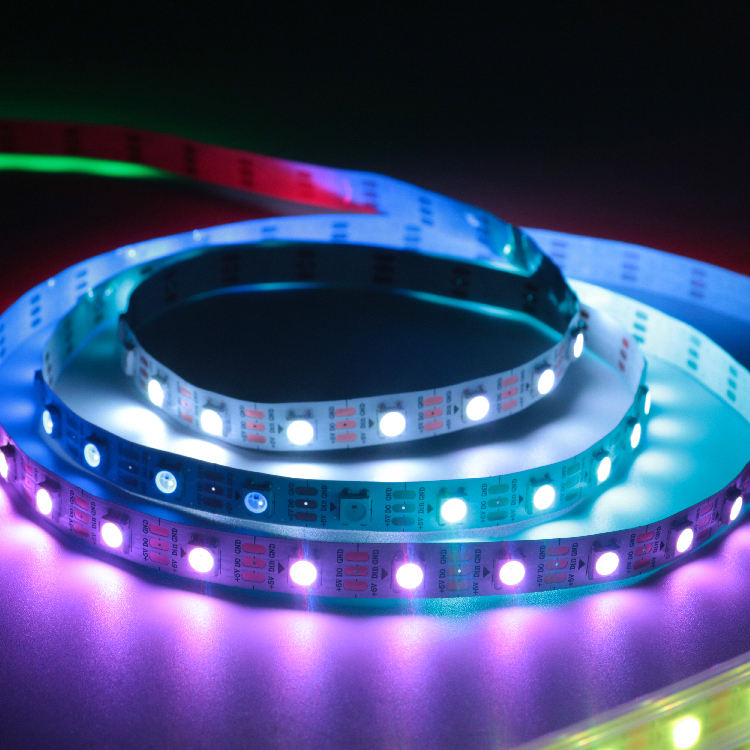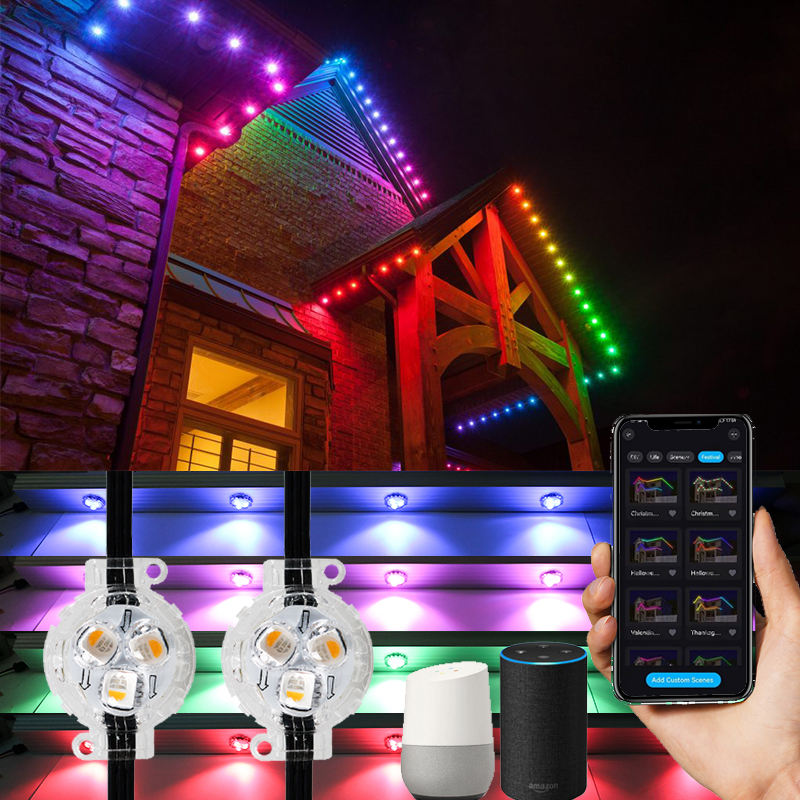
A power supply can look large enough on paper while a long Strip Light still turns dim at the far end, shifts RGB color, or flickers at full brightness. The problem is often not the total wattage printed on the driver. It is how that power reaches each section of the run. Cable resistance, strip PCB resistance, connectors, branch layout, and the chosen operating voltage all affect the voltage that remains at the LEDs. Uniform brightness therefore starts with delivery planning, not just a bigger power supply.
Why Does a Long Strip Light Run Lose Uniform Brightness?
How Voltage Drop Causes Dimming, Color Shift, and Flicker
Current flowing through a conductor creates a voltage drop. As the run gets longer, later LEDs receive less voltage. Single-color strips fade; RGB or RGBW strips can shift color or lose white output; addressable strips can show wrong pixels or flicker when the power rail is too low.
The approved SHIJILIGHTING material groups digital lighting into 5V short indoor strips, 12V medium landscape pixels, and 24V low-voltage-drop outdoor engineering versions. At SHIJILIGHTING, we use voltage, density, and W/m before planning distribution. See the LED products category.
What Is the Difference Between Cable Loss and Strip PCB Loss?
Cable loss occurs between the driver and the strip or injection point. It depends on branch current, conductor resistance, connector resistance, and round-trip distance. Strip PCB loss occurs inside the flexible copper traces, so a thick feed cable cannot remove loss along a long, narrow current path.
These losses add together. Separate power and ground wires at both ends can provide injection options, but polarity, branch current, connector quality, and far-end voltage still need checking.
Why Does a Larger Power Supply Not Automatically Fix a Dim Strip Light?
A larger driver does not shorten a cable, widen a strip PCB, reduce connector resistance, or create a second current path. A long PCB trace or high-resistance connector can still drop voltage.
Check total and branch capacity separately. Match supply voltage to the model limit: approved 12V and 5V materials include strict upper-voltage warnings.
How Do You Calculate Strip Light Power and Driver Capacity?
Which Strip Light Specifications Must Be Collected Before Calculation?
Record operating voltage, W/m, total length, LED or pixel density, color mode, controller losses, and the manufacturer’s maximum continuous length. For RGB/RGBW, calculate the most demanding simultaneous mode, usually full white. For addressable products, use the selected IC and density’s full-load figure, not a low-current animation.
Examples: SJ-10060-SK6812 is DC5V, 60 LEDs/m, 6-18 W/m; SJ-100768RGB-COB-24V is DC24V, 14 W/m. SJ-10060-8208 has 60 LEDs/m but no approved W/m value.
How Do You Calculate Total Wattage and Current for a Strip Light Run?
Use the two basic sizing equations:
Total watts = W/m x total length
Current = total watts / operating voltage
For example, 10 m at 14 W/m requires 140 W and about 5.83 A at 24V before losses. Size the driver and each branch for that load.
How to calculate Strip Light power consumption means calculating LED load and dividing it across branches. An LED strip watts per meter calculation must match the model. Amps required for a long LED strip run equals full-load watts divided by operating voltage, then checked per branch.
How Much Driver Headroom Should a Long Strip Light Installation Have?
Use sensible headroom for tolerances, heat, and controller losses, following the driver manufacturer rather than an invented percentage. Check total supply capacity separately from every output, fuse, connector, and branch.
Which Strip Light Voltage and Wiring Layout Suit a Long Run?
How Do 5V, 12V, and 24V Strip Light Systems Compare on Long Runs?
At the same wattage, higher voltage requires less current and is usually less cable-drop sensitive, but PCB and connector loss remain. The approved positioning is 5V short indoor, 12V medium landscape, and 24V outdoor engineering. Compare the waterproof addressable 12V LED strip page with the selected model. Cut unit, maximum length, controller, and W/m decide.
When Should a Strip Light Use Single-End, Center, or Dual-End Power?
Use single-end power for a short run that passes its far-end test, center feed for two shorter current paths, and dual-end power only when permitted, fused, polarity-matched, and sized for the combined load. Yes, Can LED strips be powered from both ends? They can when wired as protected parallel power paths, not an uncontrolled loop.
When Should a Long Strip Light Run Be Split into Parallel Zones?
Split the run when current is high, far-end drop is visible, the length limit would be exceeded, or one controller output is insufficient. Parallel zones make branch current and protection easier to verify; a signal connector fitting does not prove its power path is adequate.
How Should Wire Gauge and Strip Light Power Injection Be Planned?
How Do You Select Wire Gauge Using Current and Round-Trip Distance?
Choose wire gauge from branch current and full round-trip distance: positive out plus negative back. A wire gauge for LED strip lights decision based only on strip length misses the supply cable. Wire size for long LED strip runs must reflect temperature, protection, and code.
An LED strip voltage drop calculator is a screening tool; its result depends on entered current, conductor length, resistance, and temperature. Confirm it by measuring the real installation. If results disagree, inspect connections, branch routing, and actual W/m mode.
Where Should Power Be Injected into a Long Strip Light Run?
There is no safe universal injection distance. Use W/m, voltage, current per feed point, maximum length, allowed far-end drop, and full-brightness measurement. A low-W/m 24V strip may need fewer points than a high-density 5V RGBW strip. Test planned branch lengths, not just one reel.
How Should Each Strip Light Power Branch Be Connected and Protected?
Keep polarity consistent and use a common ground where required. Protect each branch for its current and cable rating. Verify connectors and injection leads for actual current; a hot connector signals resistance or overload. Outdoors, protect driver and splices from water and strain.
How Do You Test a Long Strip Light Run Before Final Installation?
How Should a Strip Light Be Tested at Full Brightness?
Before bonding or profiling, test the complete run in its highest-demanding mode: full white for RGB/RGBW or the specified maximum-current addressable scene. Do not approve it from a low-brightness animation. The customer quality material describes 24-hour full-load aging; this check follows the same demanding-state principle without claiming a factory result.
Where Should Voltage Be Measured Along the Strip Light Run?
Measure at the driver output, strip start, middle, injection points, and farthest end under the same full-brightness mode. Note visual changes and check suspect connectors.
How Can Dimming, Flickering, Hot Connectors, and Color Shift Be Diagnosed?
- End gradually dimmer: strip PCB drop, insufficient injection, or an overlong section.
- Whole run flickers: supply, controller output, loose connection, or unstable input.
- RGB color changes: a channel or return path has low voltage or a high-resistance joint.
- Hot connector: excessive current, poor crimping, or oxidation.
- Animation only fails: signal routing, controller timing, or pixel data may be at fault.
For product context, see the LED Strip Voltage Drop guide. It is a reference for the symptom, not a substitute for the selected model datasheet.
FAQ
Q: How long can a Strip Light run before voltage drop becomes visible?
A: There is no universal length. Check voltage, W/m, density, resistance, color mode, the manufacturer’s limit, and far-end voltage.
Q: What size power supply is needed for a long Strip Light run?
A: Multiply W/m by length, divide by voltage, and add headroom. Verify every output and branch. A larger supply does not fix distribution loss.
Q: Is a 12V or 24V Strip Light better for a long installation?
A: 24V often reduces current for outdoor engineering; 12V can suit medium pixels. Choose from W/m, cut unit, controller, maximum length, and far-end voltage.
Q: How often should power be injected into a Strip Light?
A: Use branch current, round-trip cable loss, maximum length, allowed far-end drop, and full-load measurements. Do not copy a fixed meter value from another model.
Q: Can a Strip Light be powered from both ends?
A: Yes, when permitted and wired as protected, polarity-matched paths. Confirm ratings, avoid current loops, and test at maximum brightness.